
This article examines where the heat pump integrated heat recovery (HPHR) approach becomes technically and economically rational, which field-level challenges must be anticipated, and how climate and system layout decisions should be made based on sound engineering logic.
In most applications, the primary objective of HPHR is not merely to increase thermal comfort, but rather to more aggressively recover energy from exhaust air in order to reduce ventilation-driven heating and cooling loads.
For this reason, HPHR systems should not be evaluated solely based on catalog efficiency values, but rather through real operational factors such as defrost behavior at low outdoor temperatures, supply air temperature stability, and the need for auxiliary heating.
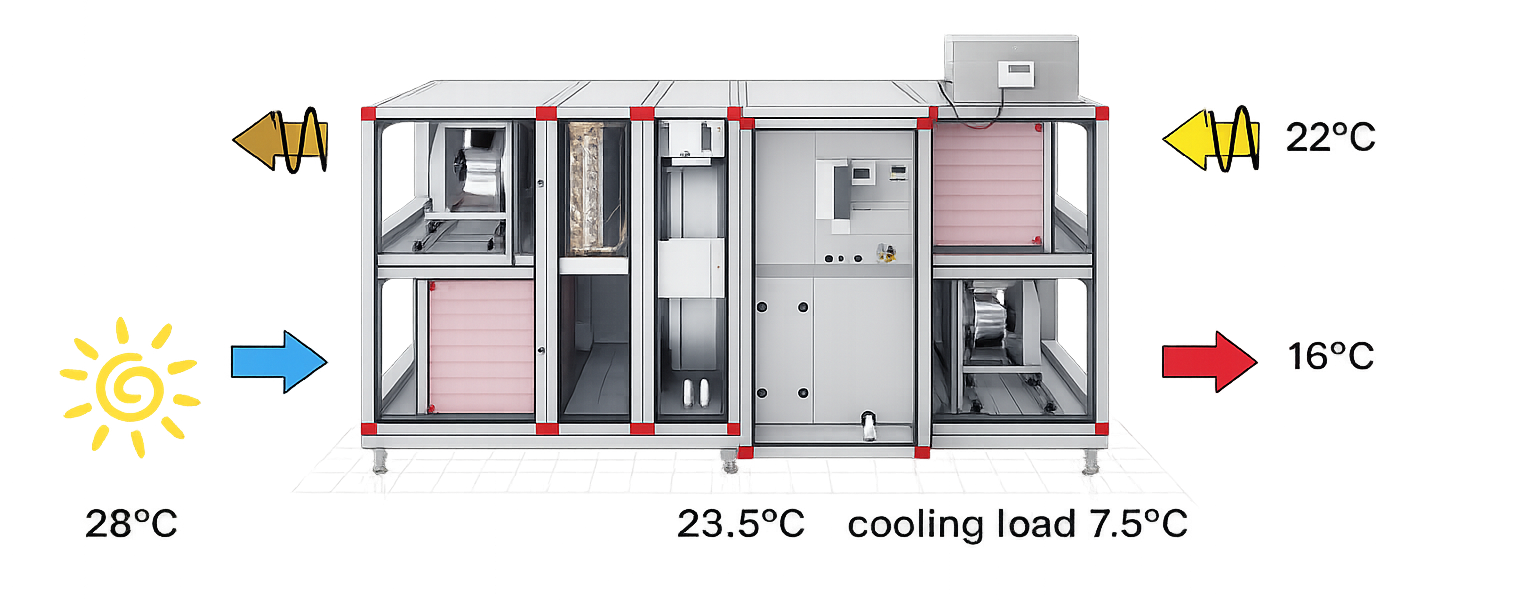
In addition, for warm-climate scenarios, the relative positioning of the evaporator, condenser, and heat recovery exchanger (rotary or plate) is shown to be critical for maintaining target supply air temperatures. In certain system architectures, incorrect component placement can significantly reduce the contribution of the heat recovery exchanger, leaving most of the thermal load to the heat pump cycle alone.
In the final section, the selection logic of crossflow, counterflow, and rotary heat exchangers is summarized together with their frost risk, leakage, and pressure drop (ΔP) impacts, illustrating how the HPHR decision must ultimately be completed at the system level, not at the component level.
What Is a Heat Pump Integrated Heat Recovery Unit?
A heat pump integrated heat recovery (HPHR) system is an integrated solution that extracts energy from exhaust (waste) air more effectively by means of a refrigerant cycle (heat pump) and transfers this energy to the supply air stream.
In practice, HPHR systems are most often configured in series with a passive heat recovery exchanger (such as a rotary wheel or plate heat exchanger). In this arrangement, primary heat recovery is first achieved via the passive exchanger, after which the heat pump cycle recovers the remaining thermal potential.
From a design perspective, manufacturers typically justify this approach by highlighting the integration of heating–ventilation (and cooling, when applicable) within a single unit, as well as reduced on-site installation and refrigerant piping requirements.
[4], [5], [8]
Temel çalışma amacı: konfor değil maksimum ısı geri kazanımı
In most applications, the fundamental goal of HPHR systems is maximum heat recovery—that is, to reduce ventilation heating loads and, when necessary, bring the supply air closer to its target temperature with minimal additional energy input.
For this reason, interpreting HPHR merely as “DX cooling inside an air handling unit” often leads to an incomplete assessment.
In real-world operation, the typical scenario is as follows:
- High-efficiency recovery via a passive exchanger (rotary or plate),
- Supplementary heating or cooling via the heat pump where passive recovery is insufficient,
- Safe operation under extreme conditions (e.g. very low outdoor temperatures) supported by auxiliary heaters when required.
[1], [8]
Spaces and Process Requirements
HPHR solutions become more rational under the following conditions:
- Systems with High Outdoor Air Ratios
Systems operating with 100% outdoor air or very high fresh air fractions—such as schools, offices, assembly areas, sports facilities, certain industrial spaces, and process ventilation applications—are typical candidates. - Buildings Dominated by Ventilation Loads
Even in buildings with low internal heat gains, high fresh air flow rates represent a significant energy component, particularly during the heating season. - Projects Targeting a Serial Heat Recovery Concept
Within the Ecodesign and Eurovent framework, basic recovery is achieved through a passive exchanger, while advanced recovery is pursued via the heat pump cycle.
[1], [2] - Projects with Installation or Space Constraints
Integrated heat pump solutions can be preferred in retrofit projects or buildings with limited rooftop space, as they reduce the need for outdoor units and extensive on-site piping.
[4], [5], [8]
Application-Driven Motivation (Heat Recovery Focus)
- Approaching high supply air temperatures during the heating season:
The passive exchanger + heat pump sequence allows the supply air to reach target temperatures while reducing reliance on auxiliary heaters.
[8] - Mitigating defrost impacts in cold climates:
When frost and defrost strategies are properly designed, energy penalties and comfort deviations caused by defrost cycles can be minimized.
[7], [8] - Cooling-season “cooling energy recovery” and integrated cooling:
In certain manufacturer concepts, coil placement within the heat pump circuit enables recovery of both heating and cooling energy, enhancing overall system efficiency.
[8]
Defrost and Low-Temperature Operating Scenarios
Defrost is a critical operating condition in heat pump–based solutions, affecting both energy consumption and supply air temperature stability.
In the RX/HC functional documentation of Swegon, multiple defrost strategies are defined to mitigate frosting risk on the exhaust (extract) coil side, including reversing the refrigerant cycle, electric heater assistance, and recirculation-supported defrost. [7]
Furthermore, the GOLD RX/HC documentation states that the defrost strategy must be selected according to the climatic design temperature; for example, recirculation-supported defrost can be applied down to lower outdoor air temperatures compared to other methods. [8]
Similarly, some manufacturers approach defrost management not merely as a control function, but as a system-architecture and layout strategy aimed at reducing or avoiding defrost demand altogether.
IV Produkt indicates that in its ThermoCooler HP solution, the heat pump coil is positioned in a warmer zone downstream of the rotary heat exchanger, thereby reducing frost risk on the coil surface and minimizing defrost requirements under certain conditions. For very low outdoor design temperatures, auxiliary (trim) heating is explicitly considered part of safe system operation. [5], [6]
On the Systemair side, the Geniox HP DF variant is positioned as a solution capable of operating at low outdoor temperatures without requiring an active defrost cycle, while in the standard Geniox HP variant, auxiliary heating or boost heaters are used to ensure safe operation at lower temperature limits. [4]
Practical Design Notes
- Defrost strategy is not a binary “on/off” issue; defrost duration, frequency, and supply air temperature deviation during defrost are key design criteria. [7], [8]
- In cold climates, coil placement and air path temperature levels have a significant impact on frost risk; some manufacturers intentionally place coils in thermally warmer sections of the unit to reduce unnecessary defrost cycles. [6]
Component Layout and System Architecture
In this context, layout refers to the sequential positioning of the heat recovery exchanger (rotary, crossflow, etc.) and the two heat pump coils (exhaust-side coil and supply-side coil) along the air paths.
Even with the same compressor and the same heat exchanger type, the relative positioning of the coils with respect to the rotary wheel can significantly affect:
- Overall heat recovery efficiency,
- Compressor temperature lift,
- Defrost frequency, and
- Cooling energy recovery potential during summer operation.
[1], [8]
To illustrate these effects, two primary climate scenarios—cold and warm—are considered below, followed by a brief reference overview for European and Turkish climate regions.
| Region | Summer | Winter |
| Warm climate | >30 °C | >-5 °C |
| Cold climate | <30 °C | <-5 °C |
Climate Zones – Reference Design Conditions
- Northwestern Europe – maritime / mild-humid
(frequent but relatively mild defrost conditions):
Netherlands (Randstad), Belgium (Brussels region), Northern France (Lille corridor), Western Germany (NRW). - Central Europe – continental / mild-cold
(defrost becomes critical at design hours):
Southern and Central Germany (Bavaria), Eastern Austria (Vienna), Eastern/Central France (Strasbourg–Lyon corridor), Northern Italy (Milan). - Alpine climate – severe winter conditions
(defrost combined with preheating or recirculation as part of system design):
Austrian Tyrol, Alpine regions of Germany, France, and Italy. - Mediterranean coastal climate – warm and often humid
(strong motivation for cooling energy recovery):
Aegean and Mediterranean coasts of Turkey, Southern Italy/Sicily, Southern coast of France. - Inland regions – hot-dry / hot-continental
(high dry-bulb temperatures, relatively low latent load):
Central and southeastern regions of Turkey (Ankara–Konya; Gaziantep/Şanlıurfa) and comparable inland zones.
Layout Strategy for Cold-Climate Applications
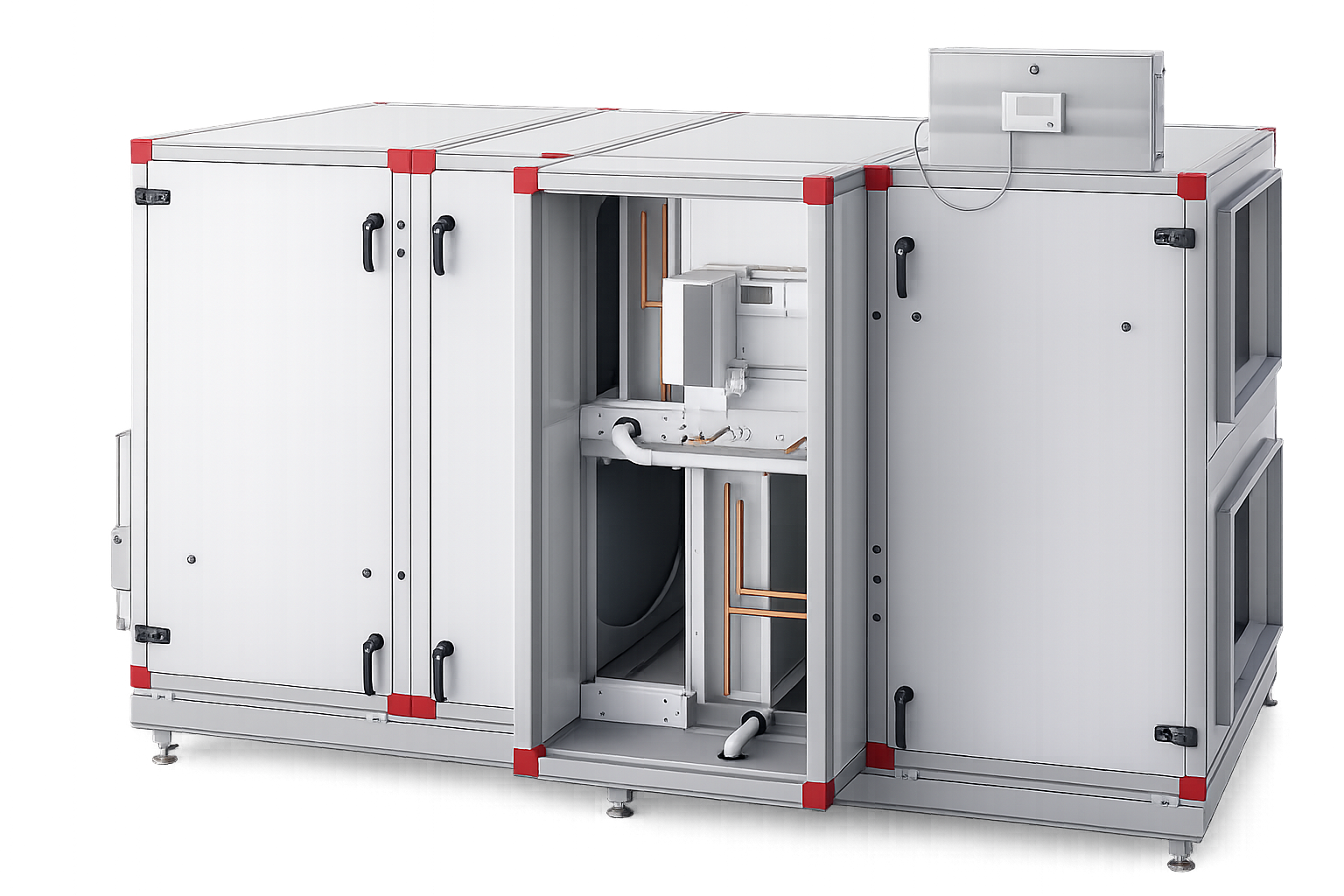
IV Produkt – ThermoCooler HP
Design objective:
In cold climates, the primary goal is to maintain the highest possible net heat recovery (including defrost and auxiliary heating effects) while minimizing losses caused by defrost cycles.
Frost behavior depends on heat exchanger type:
According to Eurovent, particularly in sensible-only plate heat exchangers, low outdoor air temperatures can lead to condensation and frosting risks. In contrast, solutions with moisture transfer capability (enthalpy/sorption) significantly reduce frost risk. Within this framework, rotary or sorption wheels may tolerate lower outdoor temperatures before frosting occurs, depending on application conditions. [1]
The air temperature “seen” by the coil is a design parameter:
Since the placement of integrated heat pump coils directly determines evaporator inlet temperature and humidity ratio, it has a direct impact on defrost demand.
IV Produkt states that placing the extract air coil on the warmer side of the thermal wheel can reduce frosting risk under sub-zero conditions and help avoid unnecessary defrost cycles. [6]
Systemair – Geniox HP
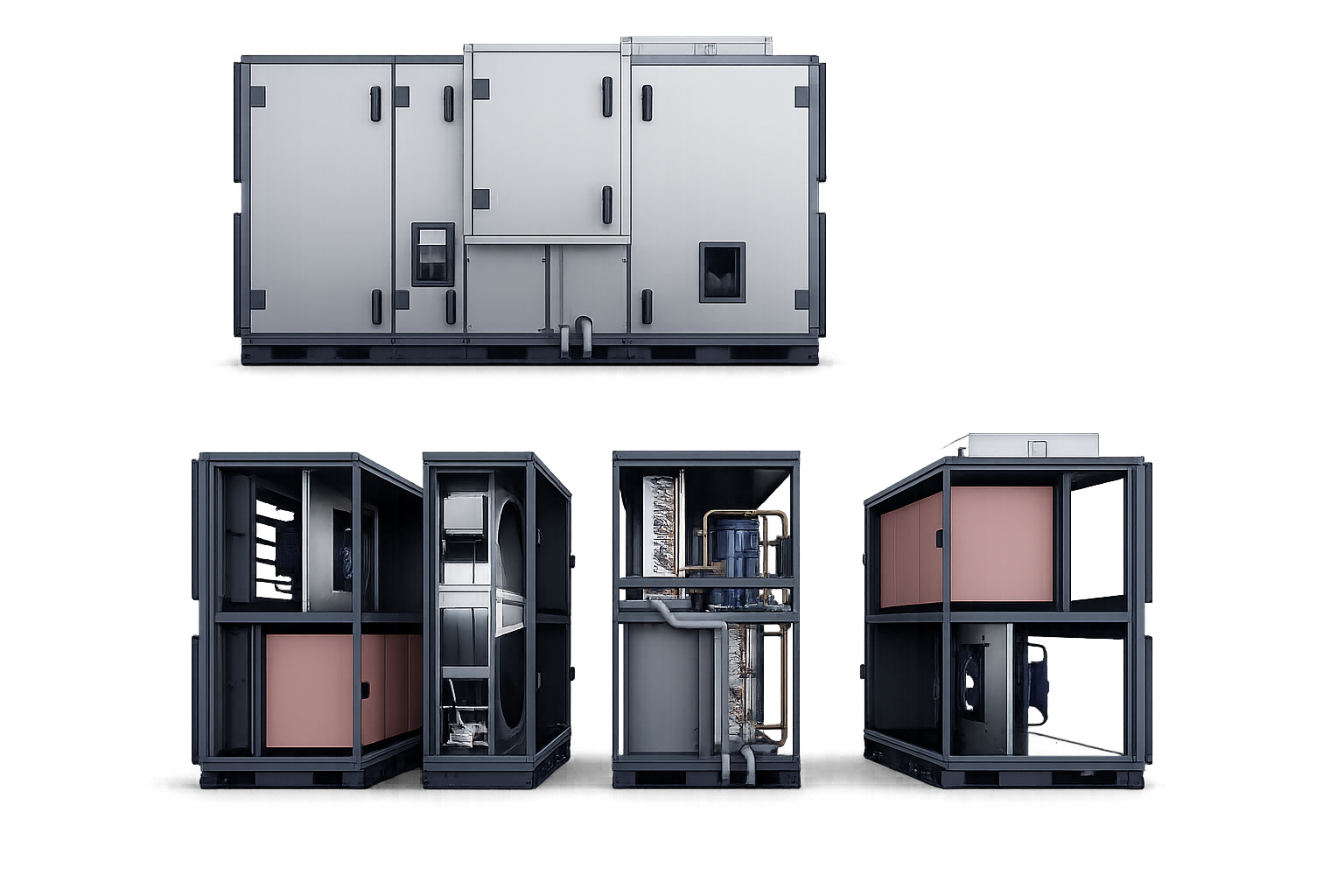
The three factors defining net benefit:
- Rotor effectiveness (temperature and moisture transfer),
- Evaporator inlet conditions (especially temperature T and humidity ratio ω),
- Defrost strategy (reverse cycle, electric preheating, recirculation, etc.).
If this triad is poorly configured, a system marketed as “high heat recovery” may result in low delivered capacity and high energy consumption under real operating conditions.
A structural drawback of this layout is observed in cooling mode: when the compressor system is active, the condenser outlet air becomes the rotor inlet, increasing the exhaust-side inlet temperature compared to the supply air side. For this reason, during cooling operation, either the rotary exchanger or the heat pump module should be selectively utilized, rather than operating both simultaneously.
Layout Strategy for Warm-Climate Applications
In warm climates, HPHR systems are typically justified by two main drivers:
- Cooling energy recovery:
Reducing the enthalpy of incoming outdoor air by recovering cooling energy from exhaust air, thereby lowering compressor load. - System integration:
Minimizing on-site complexity related to outdoor units, refrigerant piping, and split cooling systems, particularly in projects with limited rooftop or façade space, and reducing commissioning risks through a packaged solution.
Swegon – GOLD RX/HC
As with cold-climate applications, this layout must not be evaluated under a “defrost-free” assumption. In heating mode, the coil located downstream of the rotary exchanger on the exhaust air path (typically the evaporator) may be exposed to sub-zero air temperatures, increasing frost risk.
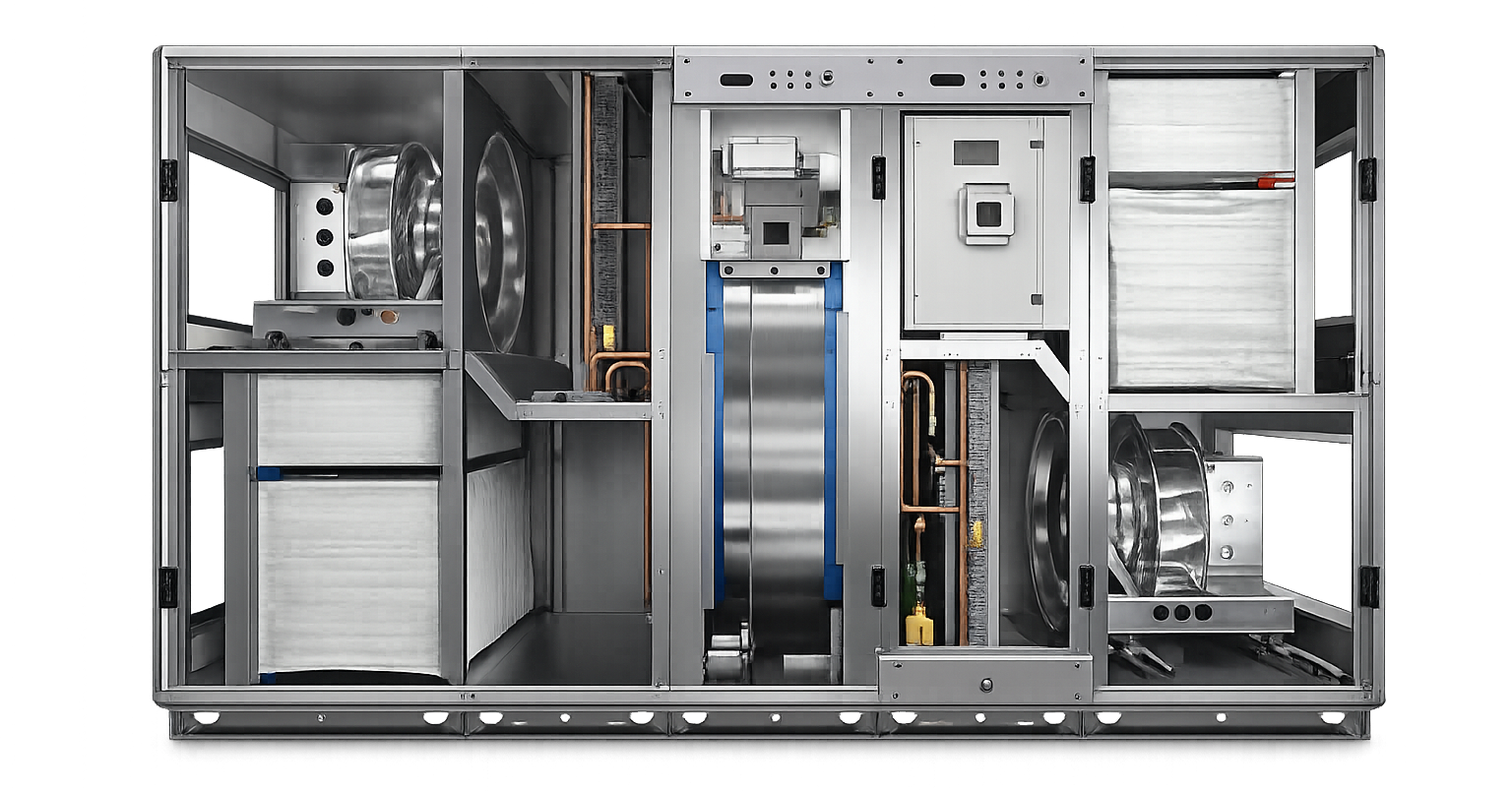
Swegon explicitly states in its RX/HC documentation that frost formation may occur on the extract/exhaust coil during heating operation, and defines the defrost strategy based on outdoor air temperature bands:
- Down to approximately –5 °C: reverse-cycle defrost may be sufficient,
- Around –10 °C: electric preheating upstream of the rotor is considered,
- At lower design temperatures: recirculation-supported defrost is recommended. [8]
IV Produkt – Envistar Series
Üretici örnekleri ve sıcaklık aralıkları: “hangi iklimde hangi yaklaşım?”
Manufacturer examples and temperature ranges: “Which approach for which climate?”
The following discussion represents an interpretative framework based on manufacturer documentation, illustrating how layout and operational logic are justified. In real projects, results are directly influenced by airflow rates, indoor conditions, filter fouling, control sequences, and the presence of bypass or recirculation components.
| Manufacturer / Series | Layout Concept | Stated Operating / Design Temperature Notes | Defrost Approach |
| Swegon – GOLD RX/HC | Rotary heat exchanger + integrated reversible heat pump; supply and exhaust coils positioned on opposite air paths of the rotor. According to the “module solutions” approach, this layout is claimed to provide more effective heat recovery in both heating and cooling modes. [8] | Defrost strategy selected according to design outdoor temperature: reverse-cycle defrost only down to approx. –5 °C; electric preheater recommended in the –5 °C to –10 °C range; recirculation-supported defrost down to approx. –25 °C. [8] | Frost formation may occur on the extract air coil during heating mode; the moisture recovery capability of the sorption rotor is stated to reduce dry-air-related frosting severity. [8] |
| IV Produkt – ThermoCooler HP | Integrated reversible heat pump module located inside the AHU; the coil is positioned on the thermal wheel warm side to reduce frosting risk. [6] | Example operating point: –12 °C outdoor air and 22 °C indoor air; compressor approx. 3600 rpm; supply air delivered at 22 °C; dry temperature efficiency ~88 %. [6] | “Warm-side” coil placement is intended to reduce frosting below 0 °C and avoid unnecessary defrost. Documentation explicitly includes the statement “No defrost cycle required” (to be validated under project-specific conditions). [6] |
| Systemair – Geniox HP DF / Geniox HP | Rotary heat exchanger + integrated reversible heat pump. DF variant positioned as “Defrost Free,” with emphasis on high net heat recovery. [4] | Geniox HP DF: heating mode down to –20 °C without preheater; “No defrosting cycle required.” Geniox HP: heating mode down to –12 °C without preheater. Design temperature –17 °C; cold-side boost heater provided as standard. [4] | In the DF variant, “defrosting cycle not required” is highlighted. This claim depends on internal control logic and coil/air conditions and should be verified via system control strategy and project-specific operation. [4] |
Heat Recovery Exchanger Types and Selection Logic
Within the Ecodesign framework and Eurovent assessments, the selection of a heat recovery exchanger is clearly defined as not solely an efficiency issue, but one that must also consider frost risk, leakage, pressure drop (ΔP), and hygiene aspects. [1], [2]
Crossflow Plate Heat Exchangers
According to Eurovent, crossflow plate exchangers are widely used, particularly in larger-scale applications, though they tend to exhibit lower temperature efficiency than counterflow designs within the same class. Efficiency can be increased by serially connecting two crossflow exchangers.
Their main advantage lies in scalability and manufacturing flexibility at high airflows. However, when targeting very high efficiency levels, exchanger size and pressure drop optimization become challenging. Additionally, as efficiency targets increase, condensation and frosting risks at low outdoor temperatures rise earlier than in rotary solutions. [1]
Counterflow Plate Heat Exchangers
Eurovent notes that very high temperature efficiencies can be achieved with counterflow plate exchangers, particularly in smaller AHU sizes, but that higher efficiency also increases frosting risk. Consequently, frost management strategies—such as bypass control, preheating, and operational logic—become critical design determinants. [1]
These solutions are well suited where efficiency is the primary objective and compact unit size is required, provided that frosting behavior is verified using manufacturer-specific data.
Rotary Heat Exchangers
According to Eurovent, rotary exchangers offer high temperature efficiency, compactness, and—when equipped with suitable rotors—moisture recovery. They may also tolerate lower outdoor temperatures before frosting occurs.
However, improper fan configuration or insufficient commissioning can increase EATR/OACF-related carryover risks, making them less suitable for high-hygiene applications. [1]
Conclusion
Heat pump integrated heat recovery solutions can significantly reduce ventilation-driven heating and cooling loads when applied in the right scenario. However, overall success is determined not by single-point catalog efficiency values, but by net operational performance over the full year.
Key parameters governing net performance include:
- Climate design conditions,
- Layout between evaporator, condenser, and heat recovery device (rotary or plate),
- Defrost strategy selection (reverse cycle, preheating, recirculation), and
- Management of auxiliary heating requirements under extreme outdoor conditions.
[4], [6], [7], [8]
References
- Eurovent AISBL / IVZW / INPA.
Eurovent 6/18 (2022) – Quality Criteria for Air Handling Units (First Edition).
https://www.eurovent.eu/wp-content/uploads/eurovent-rec-6-18-quality-criteria-for-air-handling-units-2022-en-2.pdf - European Union (EUR-Lex).
Commission Regulation (EU) No 1253/2014 – Ecodesign Requirements for Ventilation Units (2014). - Eurovent.
Air Handling Units (AHU) Guidebook – Second Edition (2021). - Systemair.
Geniox Air Handling Unit with Integrated Reversible Heat Pump (Geniox HP / Geniox HP DF) – Product documentation.
https://www.systemair.com/globalassets/product-catalogue/geniox—air-handling-units/1000-sales-and-marketing-material/geniox-hp-range-en.pdf - IV Produkt.
ThermoCooler HP – Integrated Reversible Heat Pump – Product page. - IV Produkt.
ThermoCooler HP – Technical Description and Brochure (coil layout, frost/defrost approach, example operating points).
https://www.enawent.pl/files/39/2024_1_ThermoCooler_HP_en.pdf - Swegon.
GOLD RX/HC – Function Guide (reversible heat pump, defrost strategies, outdoor air limits).
https://www.swegon.com/globalassets/digizuite/6759-en-goldrxhc_functionguide_en.pdf - Swegon.
GOLD RX/HC – Brochure (coil placement, operating range, defrost functionality).
https://www.swegon.com/globalassets/digizuite/8450-en-goldrxhc_brochure_en.pdf - ASHRAE.
Practical Guidance for Epidemic Operation of Energy Recovery Ventilators (ERVs)
(EATR, carryover mechanisms, and manufacturer data requirements). - ASHRAE.
Interpretation IC 62.1-2010-8 of ANSI/ASHRAE Standard 62.1
(Leakage, carryover, and limitations in energy recovery devices). - Eurovent Certification.
Eurovent Certified Performance Programme – Air Handling Units
(Framework for verified performance data). - Systemair – Geniox Series.
https://www.systemair.com/en-gb/products/air-handling-units/geniox/geniox-hp - IV Produkt – ThermoCooler HP / Envistar Series.
https://www.byggematerialer.dk/envistar-serien-1227674/fil-files/Brochure_Envistar_191017_02_EN.pdf
About the Author
Soykan Yaşar
Co-Founder & Technical Lead at Insolva Software and Technology
Mechanical engineer with 15+ years of experience in HVAC product development, air handling units, heat recovery systems, and heat pump–integrated solutions.
Actively working on engineering-driven HVAC selection and simulation software, with a focus on compliance and system-level performance.
Further Technical Notes on LinkedIn

https://shorturl.fm/ZlX4K