
In warm/temperate climates, equipment arrangement in “heat recovery + integrated heat pump” (HpHr-R) units directly determines not only the nominal COP/EER but also supply-air temperature stability, compressor power demand, and winter defrost continuity. Using calculation outputs produced in HVACinOne, this article interprets how rotor types (sensible/condensation/enthalpy–hygroscopic/sorption) and the summer–winter air-path arrangements affect cooling/heating performance, while also considering potential field issues.
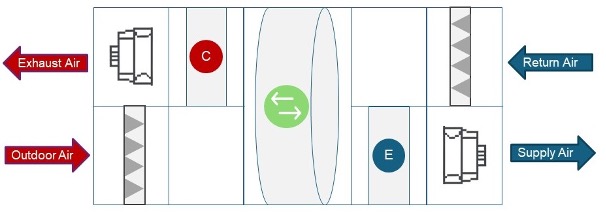
For the HVACinOne summer mode, the air flow is as shown in the figure below; in winter mode, the cycle is reversed via a four-way valve and the evaporator and condenser swap positions. In this arrangement, calculation results are interpreted using rotor types that are clearly separated in Eurovent Certita Certification programmes into categories such as “condensing / enthalpy / sorption”. [1]
Rotor Types – Application Areas
This study considers four rotor families. Each family behaves differently in terms of the nature of heat transfer (sensible/latent) and the moisture transfer mechanism (condensation, hygroscopic surface, adsorption); these differences significantly affect the evaporator load in summer and the defrost risk in winter in an HpHr-R unit. [1][2]
Condensation rotor (ST):
This class of rotors is primarily optimized for sensible heat recovery; i.e., moisture transfer is not targeted under normal operating conditions. However, if the local surface temperature drops below the dew point due to cooling of the exhaust (return) air over the rotor, condensation can occur inside the rotor matrix, and a limited latent-heat effect may appear under “wet” operation. This latent effect is not a controlled/hygroscopic transfer, but a condition-dependent condensation phenomenon. Therefore, in hot-humid climates, its ability to reduce absolute humidity on the supply-air side remains more limited than hygroscopic/sorption classes, and the evaporator may have to perform more dehumidification work. In Eurovent terminology, this group is treated as a separate product type as a “condensing wheel”. [1]
Enthalpy / Hygroscopic rotor (SE):
These rotors aim not only sensible but also latent heat (moisture) transfer by means of a coating/process that makes the surface hygroscopic (able to retain moisture). The mechanism proceeds via holding water vapour on the rotor surface and transporting it to the other air stream (an adsorption/desorption-like process); thus, the dew point / humidity ratio on the supply-air side can be reduced more effectively. However, this class may not move moisture as aggressively as sorption rotors; performance is typically bounded by “moisture recovery” targets, and especially under extremely hot-humid conditions, “moisture-driven performance deviation” may not be eliminated entirely. Within Eurovent’s moisture-recovery framework, the enthalpy/hygroscopic class is positioned in this way. [2]
Sorption rotor (HM):
Sorption rotors are designed with materials/coatings that have higher adsorption capacity in order to increase moisture transfer, and “sorption” is evaluated as a separate category in certification/terminology. [2] The practical advantage of this class is that, in hot-humid climates, it can reduce the supply air’s post-rotor absolute humidity more (thereby reducing the amount of condensate on the evaporator) and consequently improve compressor power draw and/or supply-air temperature deviation. In short: in an HpHr-R configuration, a sorption rotor acts like a “pre-conditioning element that reduces the evaporator’s latent load” in summer performance. [2][3]
Sorption hybrid rotor (SH):
Hybrid sorption rotors sit at an “intermediate” point between hygroscopic (enthalpy) and sorption behaviour: the goal is to strengthen latent-heat transfer noticeably while balancing some application constraints (cost, pressure drop, carryover targets, control flexibility, etc.). For this reason, in warm-climate designs they are often preferred as a compromise solution that meaningfully reduces latent-heat-driven performance deviation without pushing to maximum sorption effect. [3]
What rotor types are “called” is not only marketing; it also determines certification and the comparison methodology. [1][2][3] Below, a comparison of products from Hoval, Klingenburg and Heatex is reviewed.
| Rotor Class | Hoval | Klingenburg | Heatex |
| Condensation | Viskan (ST3) | Condensation wheels (aluminium film class) | Aluminium (Condensation) |
| Condensation | ST1 | Condensation rotors type P / PT | Aluminium (Condensation) |
| Condensation | SC1 (epoxy coated) | Condensation rotors type P / PT (material/protection options depending on corrosion requirements) | Epoxy (Condensation) |
| Enthalpy / Hygroscopic | Emän (SE3) | Enthalpy rotors type E / ET | Hybrid with Silica Gel or Molecular Sieve (Enthalpy) |
| Sorption hybrid | SH1 (sorption hybrid) | Enthalpy rotors type E / ET (closest class to Hoval SH1 “hybrid”) | Hybrid with Silica Gel or Molecular Sieve (molecular sieve hybrid approach) |
| Sorption | Muonio (HM1) | Hugo sorption rotor (DekaTru® coating) | Molecular Sieve Coated (Adsorption) |
Rotor types and manufacturer equivalents
To summarize briefly;
- Condensation/sensible rotor: rather than saying “no moisture transfer”, a limited latent-heat effect can occur if condensation happens, but this is not controlled moisture transfer (it is a condition-dependent phenomenon). Therefore, in hot-humid outdoor air, expectations of “reducing absolute humidity” are limited. [1]
- Enthalpy/hygroscopic rotor: moisture transfer works in both directions—humidity recovery in winter to avoid “over-drying” the indoor air, and in summer partially “drying” the supply air to reduce the coil’s latent load. However, it is not as aggressive as sorption. [2]
- Sorption (3Å molecular sieve): a molecular-sieve coating stands out with the argument of reducing cooling demand in summer thanks to high moisture effectiveness; some documents also state that it helps reduce odour transfer (selectivity). [7]
- Hybrid: in practice, the “middle solution” is typically a partial-coating approach; it becomes the most commonly used class in the cost/ΔP/performance balance. Heatex’s definition “Hybrid … (Enthalpy)” describes this approach clearly. [2]
Calculations in HVACinOne for Dry and Humid Summer Conditions and Winter Conditions
In this article’s context, the calculation workflow in HVACinOne follows the sequence below:
- The outdoor air condition (DB/RH; such as a constant DP scenario) is defined.
- Rotor calculation step: using rotor inlet conditions in the supply/return streams, rotor outlet temperature + relative humidity results are generated (in summer on the supply stream before the evaporator; in winter on the return stream before the evaporator). Latent-heat transfer behaviour differs by rotor class. [2]
- Heat-pump cycle: based on the air conditions on the evaporator/condenser sides and the target supply-air setpoint, the cycle is solved iteratively; as a result, TEvap/TCond, compressor power draw and supply-air temperature are obtained.
- Winter defrost evaluation logic: in the return stream, the risk of condensation and icing at the evaporator inlet after the rotor is based on comparing the evaporator inlet dew-point temperature (Tdp,evap,in) with the coil surface temperature (Tsurf). Tdp,evap,in is calculated from the rotor outlet temperature and relative humidity values; the condition Tsurf < Tdp,evap,in represents the threshold at which condensation starts. When the surface temperature drops below 0°C, the condensate turns into ice and an icing/defrost band forms. The risk tendency can be read from the difference ΔT = Tdp,evap,in − Tsurf (as ΔT increases, the tendency increases). [14]
Note: because the coil surface temperature is not reported directly in the HVACinOne coil library outputs, for comparison purposes Tsurf is estimated representatively using T_evap from the cycle solution.
Technical calculation performed in HVACinOne
| Type | DB °C | RH % | DP °C |
| Constant Humidity – Variable Temperature | 30 | 55,1 | 20 |
| 35 | 41,6 | 20 | |
| 40 | 31,7 | 20 | |
| 45 | 24,4 | 20 | |
| Hot-Dry Air | 30 | 35 | 12,9 |
| 35 | 30 | 14,9 | |
| 40 | 25 | 16,3 | |
| 45 | 20 | 16,9 | |
| Winter Conditions | 10 | 72 | – |
| 5 | 90 | – | |
| 0 | 90 | – | |
| -5 | 90 | – | |
| -10 | 90 | – | |
| -15 | 90 | – |
Outdoor Air Conditions Used in the Calculations
In four different unit designs, all equipment except the rotor was kept constant, and the impact of rotor type on the system under summer and winter conditions was examined. The equipment list used in this context is summarized as follows.
| Component | Manufacturer | Model |
| Supply Fan | EBM | R3G450PB2401 |
| Return Fan | EBM | R3G450PB2401 |
| Compressor | Danfoss | PSH023-4 |
| Evaporator | Friterm | M 25×22-3/8 CS 24T 6R 1000A 2,8P 24N Fin: Alu 0,12 Tube: Cop 0,4 |
| Condenser | Friterm | M 25×22-3/8 CS 24T 6R 1000A 2,8P 24N Fin: Alu 0,12 Tube: Cop 0,4 |
| Rotor List | ||
| Sorption hybrid rotor (SH) | Hoval | SH1-XL-WV-1500-SM-V1-A1-0,W1600,H1600 |
| Condensation rotor (ST) | Hoval | ST1-XL-WV-1500-SM-V1-A1-0,W1600,H1600 |
| Hygroscopic rotor (SE) | Hoval | SE3-XL-WV-1500-SM-V1-A1-0,W1600,H1600 |
| Sorption rotor molecular sieve 3Å (HM) | Hoval | HM1-XL-WV-1500-SM-V1-A1-0,W1600,H1600 |
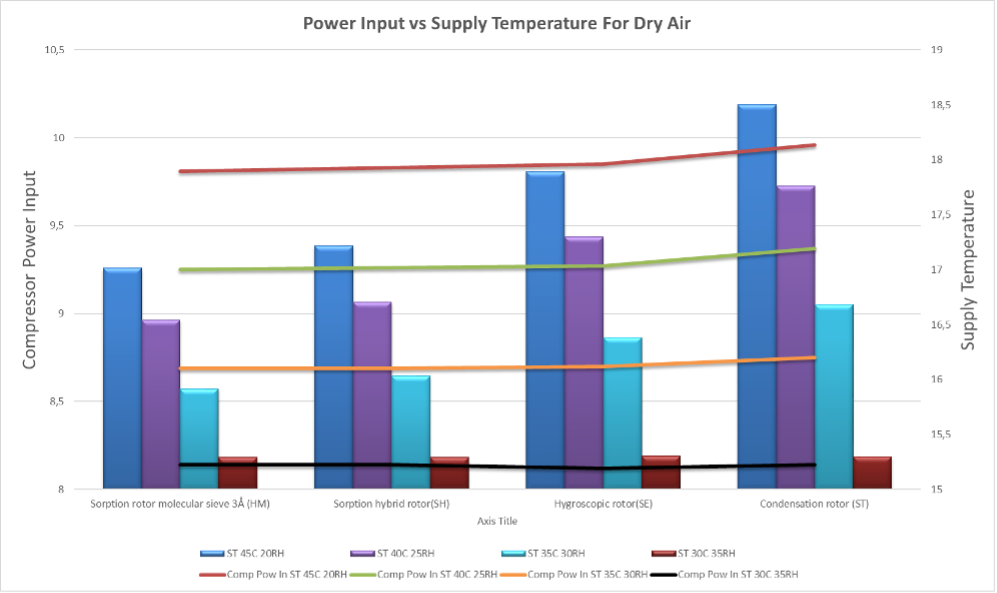
Effect of different rotor types on supply-air temperature and compressor power draw in humid and dry outdoor air
The numerical comparisons below are taken from two HVACinOne summer cases at 35°C.
Humid Air – 35°C, RH 41.6% (DP ≈ 20°C) calculation result
| Rotor | T_out_rotor (°C) | RH_out_rotor (%) | T_supply_out (°C) | P_comp (kW) | T_evap (°C) |
| Sorption (3Å MS, HM) | 25,8 | 49,7 | 16,39 | 8,71 | 8 |
| Sorption-hybrid (SH) | 25,8 | 53,4 | 16,94 | 8,78 | 8,6 |
| Enthalpy/Hygroscopic (SE) | 26 | 61,3 | 18,2 | 8,88 | 9,8 |
| Condensation (ST) | 25,8 | 71,3 | 19,38 | 9,03 | 11,1 |
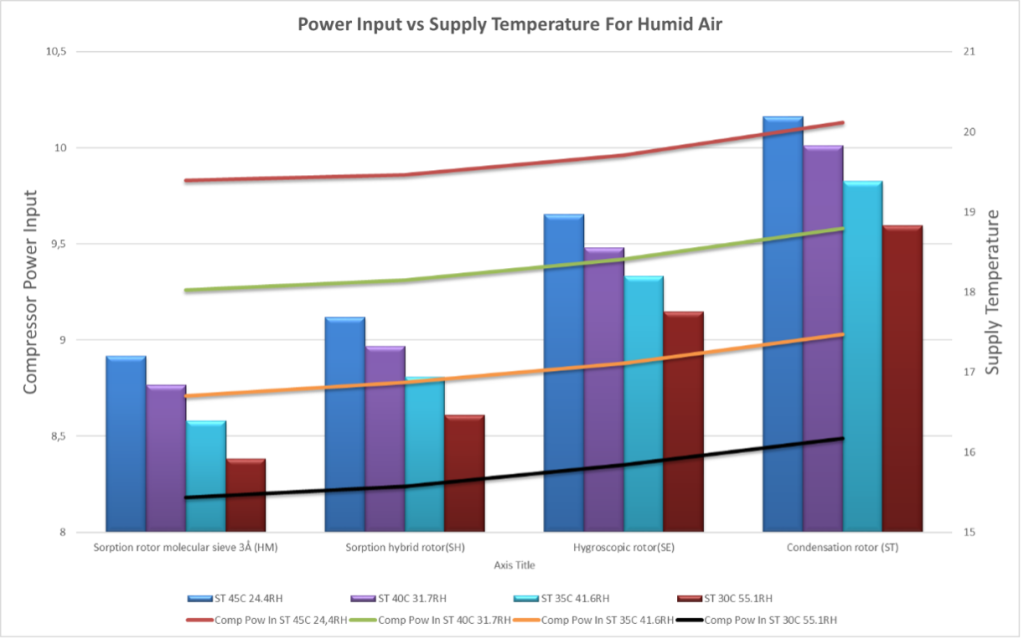
- In humid outdoor air, the post-rotor RH levels diverge significantly by rotor type; this increases the evaporator’s latent load (and thus compressor power). Rotor type definitions and moisture transfer behaviour are explained within the Eurovent framework via the distinction “sorption / enthalpy / condensing”. [1][2]
- In the configuration that “carries” the most moisture (ST in this dataset), compressor power increases even though T_evap rises, because the evaporator’s latent load increases; in practice, this pushes the supply-air temperature upward as a latent-heat-driven performance deviation during summer operation.
Dry Air – 35°C, RH 30% calculation result
| Rotor | T_out_rotor (°C) | RH_out_rotor (%) | T_supply_out (°C) | P_comp (kW) | T_evap (°C) |
| Sorption (3Å MS, HM) | 25,8 | 46 | 15,91 | 8,69 | 7,6 |
| Sorption-hybrid (SH) | 25,8 | 46,9 | 16,03 | 8,69 | 7,7 |
| Enthalpy/Hygroscopic (SE) | 26 | 48,3 | 16,38 | 8,7 | 8 |
| Condensation (ST) | 25,8 | 51,4 | 16,68 | 8,75 | 8,3 |
Latent heat impact map (Humid − Dry @ 35°C):
| Rotor | ΔT_supply_out (°C) | ΔP_comp (kW) |
| Sorption (3Å MS, HM) | 0,48 | 0,02 |
| Sorption-hybrid (SH) | 0,91 | 0,09 |
| Enthalpy/Hygroscopic (SE) | 1,82 | 0,18 |
| Condensation (ST) | 2,7 | 0,28 |
At the same DB=35 °C point, when absolute humidity (DP) increases (Dry → Humid), an adverse deviation of +0.5 °C to +2.7 °C is observed in supply-air temperature depending on rotor type; in parallel, compressor power increases by +0.02 kW to +0.28 kW. The physical/mechanical meaning of this difference is as follows: in summer operation, because the rotor is located upstream of the evaporator in the supply-air stream, the rotor’s moisture (latent) transfer changes the dew point and humidity ratio of the air entering the evaporator; thus the evaporator’s duty can shift from purely sensible cooling toward a load dominated by moisture removal (latent cooling/condensation). As a result, the cycle is more heavily loaded to meet the same supply-air temperature target and compressor power tends to increase. Eurovent’s “moisture recovery” framework defines exactly this point by classifying rotors as condensing / enthalpy / sorption—i.e., under which conditions and by which mechanism the rotor transfers moisture, and how this reflects on system loads; therefore, separating a hot-dry profile from a constant-DP profile makes the differences between rotor types visible in a “latent-heat-sensitive” way. [2]
Compressor system continuity under winter inlet air conditions for four different rotor types
In winter mode, since the flow order is Return: Filter → Fan → Rotor → Evaporator, the rotor’s heat recovery cools the return air upstream of the evaporator. In this arrangement, two axes that determine continuity should be read together:
- Whether icing will start (risk): if the evaporator surface drops below 0°C and the surface temperature is also below the dew point of the inlet air (Tsurf < 0°C and Tsurf < Tdp,evap,in), the system enters the icing band. [9][14]
- How fast ice accumulation will progress (rate): once in the icing band, the accumulation rate tends to increase as the “driving difference” for mass transfer between the moisture level in the air stream and the saturation level at the frost surface increases. This approach is defined as the driving potential in frost growth models. [15][16]
Assumption between evaporation temperature and surface temperature
Since the quantity read directly from the cycle solution in HVACinOne output is T_evap (the refrigerant evaporation temperature), a practical approach is used for the coil surface temperature:
Tsurf,est ≈ T_evap + 2 K
This assumption is suitable for making a relative continuity comparison between rotor types rather than predicting an absolute defrost time.
Approach for post-rotor humidity ratio, dew point and evaporator surface temperature to be used in the defrost process
The air condition at the evaporator inlet is read from the post-rotor return stream. At this point:
- Dew point (Tdp,evap,in) allows the condensation/icing threshold to be read with a single number: by comparing Tdp,evap,in with Tsurf, a “dry coil / wet coil” distinction is made, and the icing band is defined below 0°C. [14]
- Humidity ratio (w_in) is useful for distinguishing the accumulation rate: at the same surface temperature, as w_in increases, the water-vapour flux transported to the frost surface tends to increase (the mass-transfer driving difference grows). The w_in values are taken from the humidity-ratio column reported for the post-rotor evaporator inlet air in the HVACinOne winter technical output. [15][16]
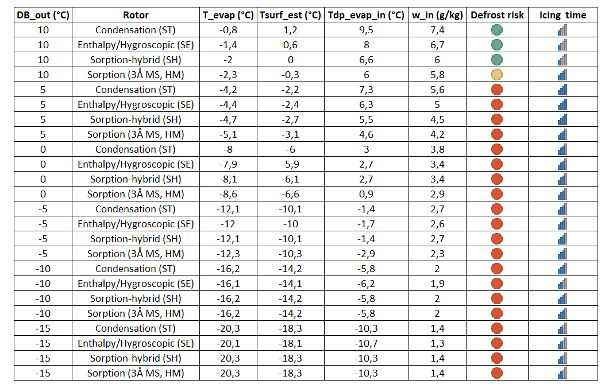
Frosting risk and rate versus outdoor air temperature for different rotor types
Note: the “frosting rate” classification is consistent with the driving-difference approach that determines mass transfer to an ice/frost surface; as w_in decreases (drier air), the accumulation rate also tends to weaken. [15][16]
Which system is more prone to defrost at which temperature
This dataset communicates the continuity message driven by the arrangement very clearly:
- DB_out = 10°C: For three rotor families (ST, SE, SH), Tsurf,est remains above/around 0°C, so the system does not enter the icing band. By contrast, in the HM rotor, Tsurf,est drops just below 0°C, creating a possibility of icing in the boundary region.
- DB_out = 5°C: For all four rotor families, Tsurf,est drops clearly below 0°C and the condition Tsurf,est < Tdp,evap,in is satisfied; i.e., all enter the high-risk band. Here, the difference shifts from “does it start?” to “how fast does it progress?”: on the ST/SE/SH side, the higher w_in makes the fast class dominant; HM remains at a medium rate at the same outdoor point due to a relatively lower w_in.
- out ≤ 0°C: The icing band is strongly satisfied for all types; as T_evap converges across rotor types, the continuity difference decreases and defrost management becomes decisive.
- DB_out = −10…−15°C: Risk is still high; however, because the air is drier, the accumulation rate shifts toward the slow class.
Once icing starts, two critical field effects come into play: the air path narrows → pressure drop increases → fan power rises, and at the same time heat-recovery/heat-transfer performance deteriorates. [8]
As a result, in this arrangement, continuity at low outdoor temperatures typically requires an active defrost strategy regardless of rotor type. In integrated reversible heat-pump applications, defrost options such as cycle reversal, auxiliary heating, and recirculation are explicitly defined in manufacturers’ function guides. [10]
Conclusion
- Summer performance (example DB=35°C): under humid-air conditions, rotor types create latent-heat-driven performance deviation of +0.5…+2.7°C in supply-air temperature because they change the evaporator’s latent load; compressor power increases by +0.02…+0.28 kW (in this dataset).
- The decisive impact of arrangement: positioning the rotor upstream of the evaporator in summer can offer a supply-air “pre-conditioning” potential (especially on the moisture/enthalpy side); in winter, the same arrangement tends to carry a colder source to the evaporator after the rotor on the return stream, pulling TEvap downward and potentially widening the defrost window.
- Winter continuity: at DB=5°C and below, risk increases for all rotor types; below this band, continuity often makes defrost management (cycle reversal, electric backup, recirculation/bypass, etc.) and, if needed, a preheater approach part of the design regardless of rotor type. [8][9][10]
- Market approach: in the integrated solutions market, manufacturers such as Systemair (Geniox HP) and Swegon position the concept of “integrated reversible heat pump + rotary heat exchanger” as a product family; climate coverage and defrost strategy are treated as core decision headings of the product architecture. [11][12]
- Component/section diversity: IV Produkt offers an integrated cooling section (e.g., EcoCooler) with a rotary heat exchanger or a modular section approach, showing that different heating/cooling architectures can be configured on the same “air path”. [13]
References
- Eurovent Certified Performance: AARE – Rotary Heat Exchangers (certification programme scope and classifications).
- Eurovent Recommendation 17/14 (2025): Moisture recovery in ventilation and air-conditioning systems.
- Systemair blog (2022): Energy Recovery – Rotary Heat Exchanger Types (condensation/enthalpy/hygroscopic/sorption classes and application notes).
- Hoval Energy Recovery Portal: Sorption rotary heat exchanger – principle and product framework.
- Klingenburg: HUgo sorption rotor family (DekaTru® coating) – technical documentation and type coding.
- Heatex: Segmented / enthalpy / adsorption rotor media options (Model EQ and related product documents).
- Östberg: 3Å molecular sieve coating approach and selectivity arguments.
- Swegon blog (2024): Condensation and frosting in rotary heat exchangers (effects of frosting on pressure drop and performance).
- ASHRAE Handbook—HVAC Systems and Equipment: Air-to-Air Energy Recovery Equipment (condensation and frosting mechanisms, frost formation).
- Swegon (Function Guide): GOLD RX/HC – Reversible heat pump (defrost options and control logic).
- Systemair: Geniox HP – integrated reversible heat pump + rotary heat exchanger (product architecture and climate coverage).
- Swegon: GOLD RX/HC – all-in-one AHU + reversible heat pump (product concept and application framework).
- IV Produkt: EcoCooler – integrated cooling unit / section approach (example of a modular section).
- Wood, L.A. (1970). The use of dew-point temperature in humidity calculations. Journal of Research of the National Bureau of Standards—C.
- Na, B. & Webb, R.L. (2004). Mass transfer on and within a frost layer. International Journal of Heat and Mass Transfer, 47(5), 899–911.
- Kandula, M. (2011). Frost growth and densification in laminar flow over flat surfaces. NASA Technical Report (NTRS).
About the Author
Soykan Yaşar
Co-Founder & Technical Lead at Insolva Software and Technology
Mechanical engineer with 15+ years of experience in HVAC product development, air handling units, heat recovery systems, and heat pump–integrated solutions.
Actively working on engineering-driven HVAC selection and simulation software, with a focus on compliance and system-level performance.
Further Technical Notes on LinkedIn

https://shorturl.fm/EK6np