How much air does a condenser fan really deliver through the coil? The condenser air flow sets the condensing temperature, and the condensing temperature sets much of the refrigeration cycle. Yet in a manual calculation it is often one number, typed once. If it is too high, the fan cannot deliver it. If it is too low, the condenser runs hot. In both cases the result rests on a guess.
The physics gives the answer. A fan curve falls: the more air the fan moves, the less pressure it has left. The coil resistance rises: the more air goes through the fins, the more pressure drop it causes. The real air flow is the operating point where the two curves meet.
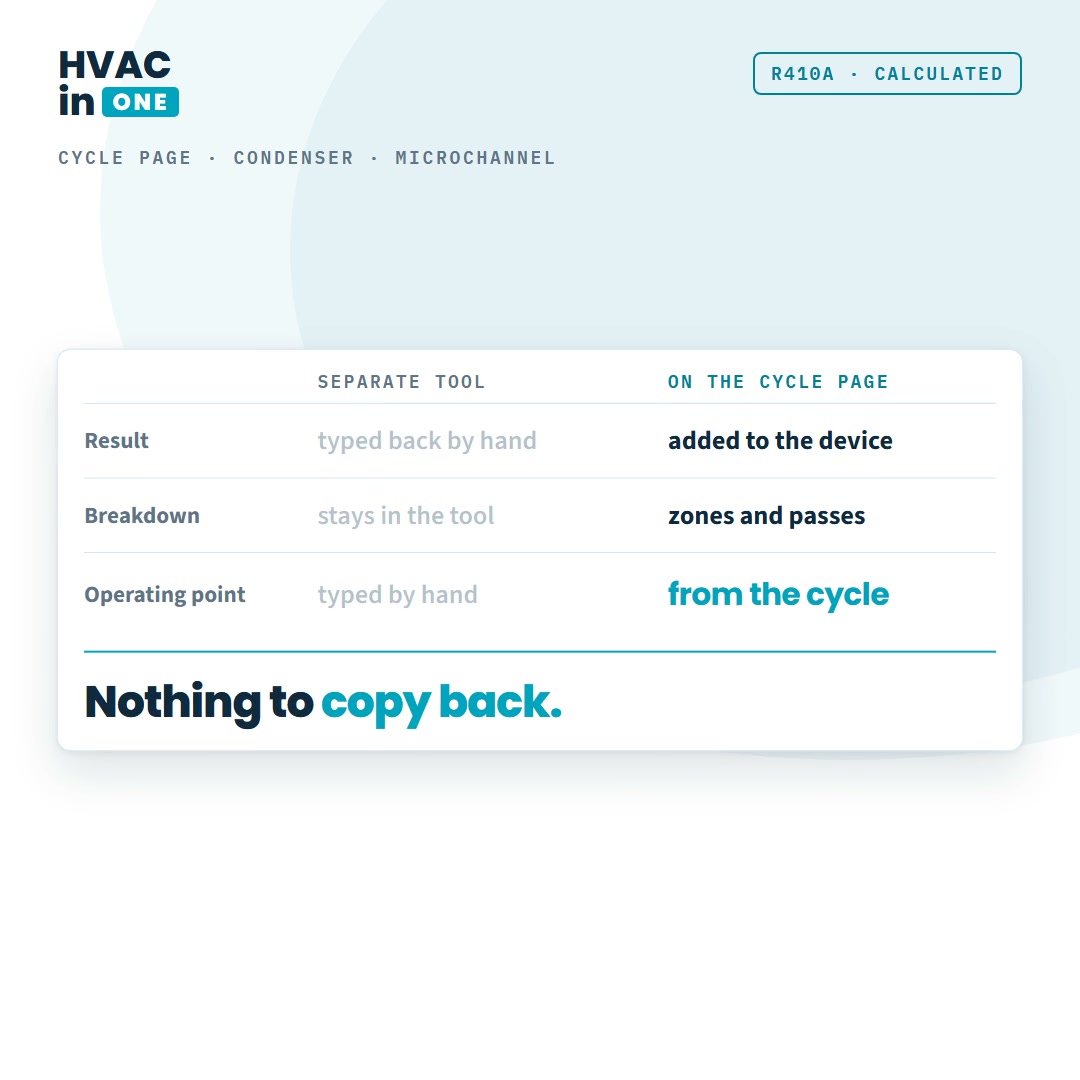
In auto condenser fan mode, HVACinOne finds that operating point in every calculation. It takes the curve of the selected axial fan and the air side resistance of the condenser coil, and solves where they meet. The cycle is then calculated with this air flow, so the condensing temperature follows from the fan and the coil, not from a typed value.
Take a rooftop unit in summer at 35 °C outdoor. The operating point gives 11044 m³/h at the fan, 66 Pa air pressure drop over the coil, a fan speed of 1834 rpm, 1.40 kW fan power and 48.0 °C condensing. Selection engineers of rooftop and condensing units get a condenser side they can trust, with fan power and speed from the same point.