A microchannel condenser is often rated in a separate selection tool. The engineer types the condensing temperature, discharge superheat and subcooling into that tool by hand. Then the capacity and the pressure drop are typed back into the unit. When the cycle changes, the two sides drift apart. The split between desuperheating, condensing and subcooling stays hidden inside the tool.
In HVACinOne the microchannel condenser is selected on the same Cycle page as the fin-and-tube condenser. The operating point comes straight from the cycle: refrigerant, condensing temperature, superheat, subcooling and refrigerant flow. You set the tube family, tube count, number of passes, pass split, finned length and fin pitch. HVACinOne rates the coil pass by pass and splits the capacity into the desuperheat, two-phase and subcooling zones. Air-side and refrigerant-side pressure drop come in the same result, and the selected condenser is added to the device.
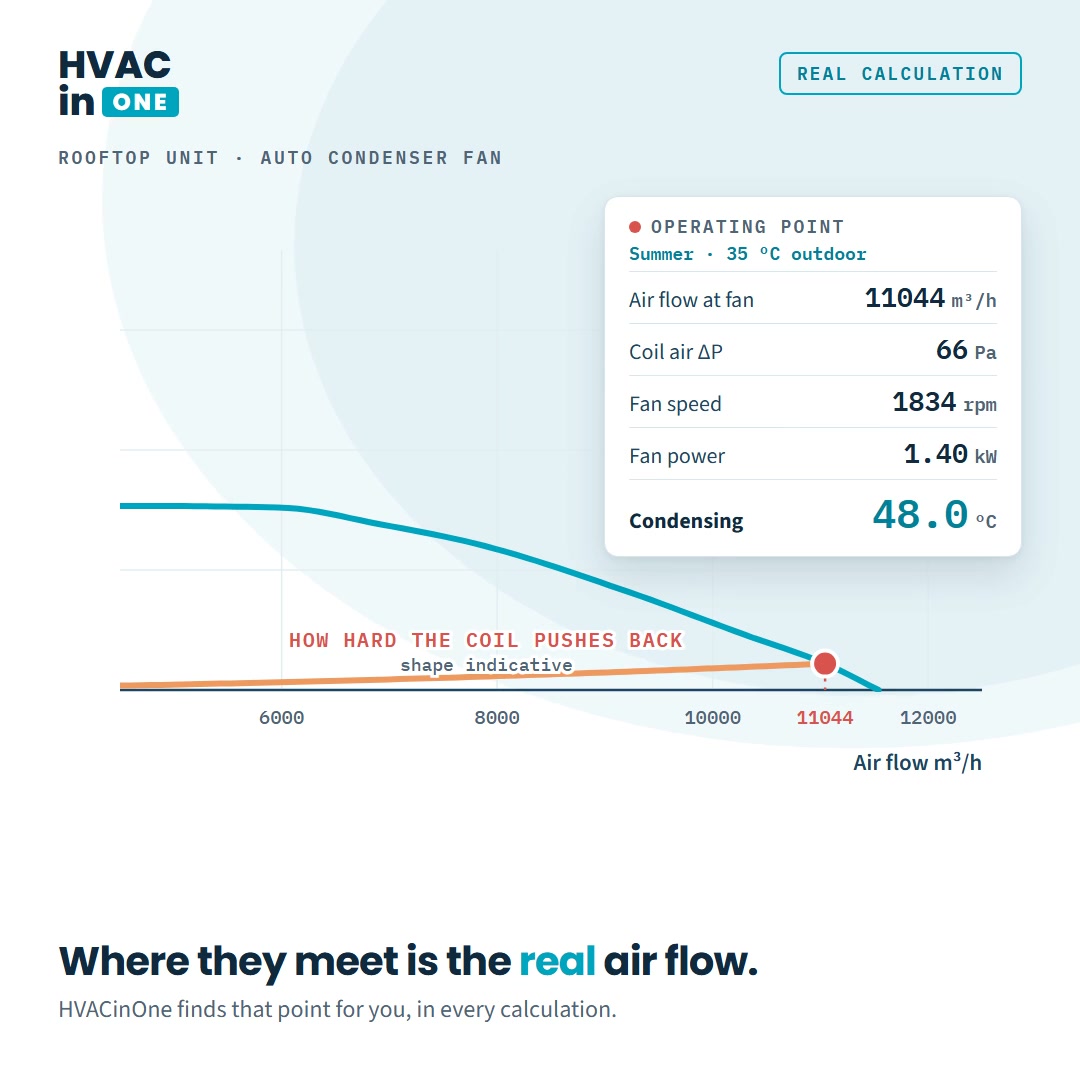
Take a real R410A cycle: 7 °C evaporating, 45 °C condensing, 30 K discharge superheat and 5 K subcooling, with a 24.4 kW compressor. The microchannel condenser has 65 tubes in 3 passes, split 25 / 22 / 18, and a finned length of 2000 mm. It gets 11000 m³/h of air at 35 °C. The result is 30.8 kW in total: 6.77 kW desuperheat, 22.55 kW two-phase and 1.48 kW subcooling. On the air side the pressure drop is 54 Pa, the face velocity 2.50 m/s and the leaving air 43.7 °C. On the refrigerant side the mass flow is 540 kg/h and the pressure drop 66 kPa.
This helps selection engineers who use microchannel condensers in DX units. The condenser is checked against the cycle it really works in, the zone split shows how the coil surface is used, and there is nothing to copy back.